Dive Brief:
- The Federal Reserve, in a decision with one dissent, held the main interest rate steady on Wednesday, flagging the uncertain economic impact from the Iran war as the conflict propelled the price of oil to its highest level in nearly four years.
- Fed officials in a median projection forecast one quarter-point reduction in the federal funds rate in 2026, the same as their estimate in December. They expect that their preferred measure of inflation — the personal consumption expenditures price index less volatile food and energy prices — will end 2026 at 2.7%, 0.2 percentage point higher than their December estimate. They raised their forecast for economic growth this year to 2.4% from 2.3% in December. Fed officials also estimate that the unemployment rate will end 2026 at 4.4%, unchanged from their December forecast.
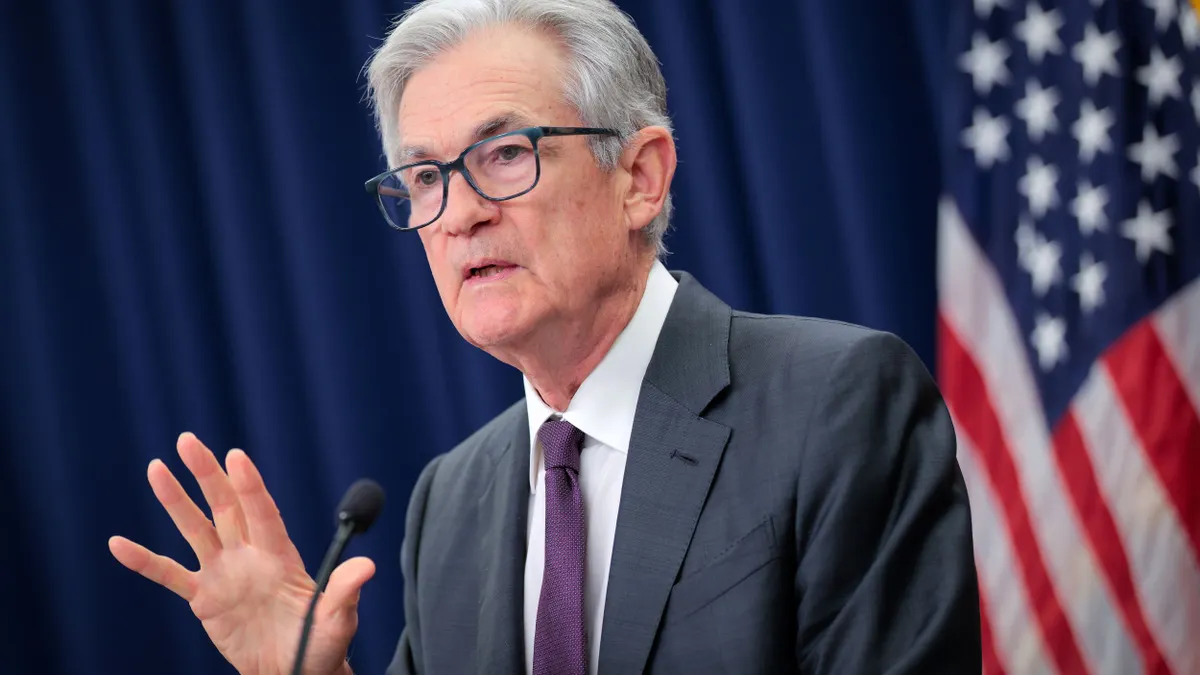
- “The implications of events in the Middle East for the U.S. economy are uncertain,” Fed Chair Jerome Powell said during a press conference after a two-day policy meeting. “In the near term, higher energy prices will push up overall inflation, but it is too soon to know the scope and duration of the potential effects on the economy.”
Dive Insight:
Fed policymakers, since setting the main interest rate at a range from 3.5% to 3.75%, have tried for several weeks to finely calibrate borrowing costs to conflicting risks posed by rising unemployment and accelerating inflation.
The central bank’s policy dilemma has worsened this month as the Iran war spurred a jump in energy prices, threatening to increase inflation, slow economic growth and push up unemploymen
“I’d be hard pressed to say that one of them is more at risk than the other,” Powell said, referring to the Fed’s congressional mandate to ensure stable prices and full employment.
“We're in a difficult situation,” he said, noting the current challenge of balancing the two sides of the Fed’s mandate.
“We feel like where we are now is just kind of on that borderline, the higher borderline of restrictive versus not restrictive,” he said, indicating policymakers currently lean toward maintaining borrowing costs at current levels rather than trimming them. “We feel like that's the right place to be.”
Since the renewal of hostilities between Iran and both the U.S. and Israel on Feb. 28, futures for Brent crude oil, the global benchmark, have rocketed by about 48%, from $73 per barrel to $108 per barrel.
Meanwhile, the average price for a gallon of regular gasoline has shot up during the past month by 31%, according to AAA.
Inflation was rising before the U.S. and Israel launched air strikes on Iran and has persisted above the Fed’s 2% target for five years.
So-called core PCE, the central bank’s preferred measure of price pressures, rose 3.1% in January from 3% in December.
Fed officials are eager to see the price of goods fall as the highest U.S. tariffs since the 1930s work their way through the economy by mid-year, Powell said.
“The thing that's really important that we see this year is progress on inflation, through a reduction in goods inflation as the one-time effects on prices of tariffs go through the system,” he said.
“That's the main thing we're looking for going into this exercise,” he added, noting recent inflation data indicate “we didn't make progress.”
The Fed has tried for five years to slow inflation to its 2% goal in the face of Russia’s invasion of Ukraine, the imposition of U.S. tariffs and the spike in oil prices during the recent renewed conflict with Iran, Powell said.
“It's a repeated set of things,” he said, adding “you worry that that's the kind of thing that can cause trouble for inflation expectations and so we worry a lot about that.”
“We are very strongly committed to doing what it takes to keep inflation expectations anchored at 2%,” Powell said.
The job market, like inflation, has trended against the Fed’s dual congressional mandate in recent months, prompting two policymakers to dissent against a FOMC decision in January to leave the federal funds rate unchanged. Fed Governor Stephan Miran on Wednesday dissented again, favoring a quarter-point reduction in the benchmark rate.
The economy unexpectedly lost 92,000 jobs in February, pushing up the unemployment rate 0.1 percentage point to 4.4%. Job losses spanned the full range of industries — from manufacturing and warehousing to transportation and healthcare.
Powell said he intends to serve as Fed chair pro tempore after his term expires in May if his successor is not confirmed by the Senate by that time.
After confirmation of a new chair, Powell said he will continue to serve as a Fed governor until the Justice Department concludes an investigation into renovation of the central bank headquarters in Washington.
Powell said he has not decided whether to continue serving out his term as a governor after the investigation is over. His term ends in January 2028.